Garage door automation: sectional vs. tilting vs. roll – what you choose
Do you need help choosing?
Tell us what you need and we'll send you the offer on the same working day.
Garage door automation: sectional vs. tilting vs. roll – what you choose
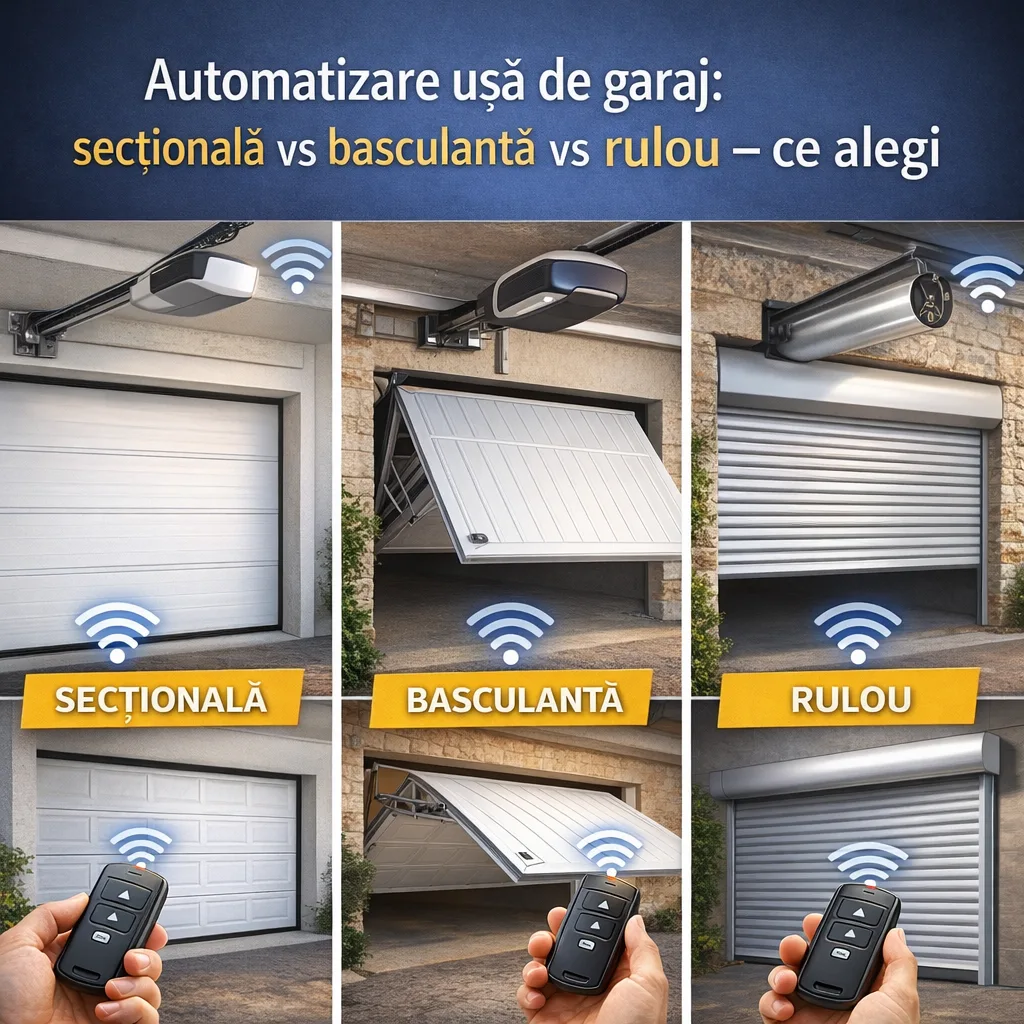
Automation of the garage door brings greater comfort, safety and efficiency, regardless of whether we are talking about a private home or a commercial space. The choice of the right system depends, however, on the type of door: sectional, tilting or roll. Each variant has different characteristics that influence the operation, costs and durability of automation.
Why is the type of door important before automation
Not all garage doors are automated the same. Weight, harvest mode and available space determine the type of motor and the necessary accessories. A correct choice prevents premature wear and ensures safe operation in the long term.
Automation of the sectional garage door
The sectional doors are made up of articulated panels that slide on vertical and horizontal rails. They are the easiest to automate due to the uniform distribution of weight.
Advantage
- Silent operation
- Excellent compatibility with ceiling type motors
- Good sealing and thermal efficiency
- Ideal for residential garages
Verification aspects
- Well-adjusted arches
- Straight and clean rails
- Fair door balance
Automation of the tilting garage door
The tilting doors are made from a single panel which lifts and tilts to the inside. I'm robust, but more demanding for the motor.
Advantage
- Simple construction
- Lower initial cost
- Good mechanical strength
Limitations
- Needs free space in front of the garage
- Noiseier operation
- More demanding motor automation
Recommendation
It is important that the mechanism is perfectly balanced before automation.
Automation of the rolling garage door
Roller doors work similar to outside rollers, the panels running in a top cassette. Automation is directly integrated into the ax.
Advantage
- Maximum space saving
- Quick installation
- Modern design
- Ideal for small garages
Limitations
- Lower thermal insulation
- Higher cost for quality models
- Sensitive incorrect mounting
Quick comparison between types
- Sectional door – the best balance between comfort and durability.
- The tipping door – robust solution, requires attention to automation.
- Roller door – ideal for limited spaces and compact appearance.
What type of automation is used
- Sectional doors: roof type motor with rail
- Switching doors: powerful motor with adapted stroke
- Roller doors: integrated tubular motor
The choice of engine power shall take into account the weight of the door and the frequency of use.
Security and recommended functions
- Detection obstacles
- Safety photocells
- Manual release in case of power failure
- Remote control or control from the application
Conclusion
Choosing the right automation starts with the type of garage door. A sectional door offers the best balance between comfort and performance, the tilting door remains a solid option, and the roll door is the ideal solution for limited spaces. Proper automation ensures safety, durability and daily comfort.