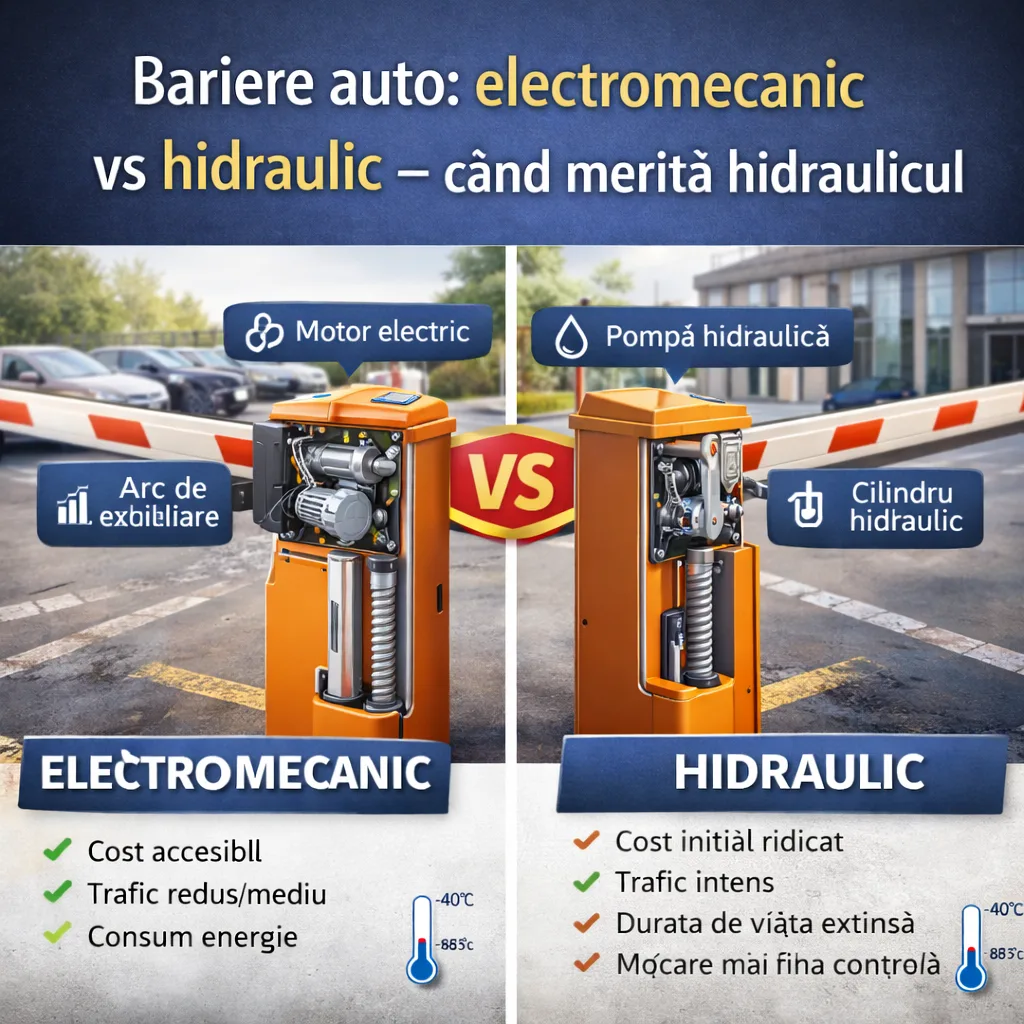
Auto barriers: electromechanical vs hydraulic – when worth the hydraulic
Do you need help choosing?
Tell us what you need and we'll send you the offer on the same working day.
Auto barriers: electromechanical vs hydraulic – when worth the hydraulic
Car barriers are essential solutions for control of access in parking lots, residential areas, commercial or industrial spaces. One of the most common dilemmas when choosing a barrier is the type of action: electromechanical or hydraulic. Although both variants perform the same function, the differences between them are significant, especially in terms of the intensity of use and sustainability.
Electromechanical car barriers
Electromechanical barriers use an electric motor, reducer and balancing arc to lift and lower the arm. They are the most widespread in standard residential and commercial applications.
Advantage
- Lower purchase cost
- Simple installation
- Low energy consumption
- Easy maintenance
Limitations
- Recommended for medium traffic
- Faster use in intensive care
- Sensitive to large temperature variations
Self-hydraulic barriers
Hydraulic barriers use a hydraulic pump system and cylinder for arm movement. They are designed for applications with intense traffic and continuous operation.
Advantage
- High resistance to intensive use
- Longer life
- Constant operation at extreme temperatures
- Smoother and controlled movement
Limitations
- Higher initial cost
- More complex installation
- Professional maintenance required
Key differences between electromechanical and hydraulic
Electromechanical barriers are ideal for occasional or medium use, while hydraulic barriers are designed for intensive and non-stop work cycles. The major difference is in the mode of action and the ability to sustain a large number of openings per hour without overheating.
When it's worth choosing a hydraulic barrier
- Very intense traffic (public parking, shopping malls)
- Continuous operation 24/7
- Industrial environments or zones exposed to extreme temperatures
- Maximum long-term reliability needs
In these situations, the larger initial investment is justified by reduced maintenance costs and extended lifespan.
When there is enough an electromechanical barrier
- Residential parks
- Private or semi-public access
- Reduced or medium traffic
- Limited budget
For such applications, a well-chosen electromechanical barrier provides very good performance.
Security and additional functions
Regardless of the type of barrier, it is recommended to equip:
- Safety photocells
- Signal light
- Manual unlocking systems
- Integration with RFID cards, remote controls or GSM systems
Conclusion
The choice between an electromechanical barrier and a hydraulic barrier shall be based on the level of traffic and the conditions of use. Electromechanical barriers are efficient and economical for standard use, while hydraulic barriers are the ideal solution when maximum reliability and intensive operation are needed.